SB 1117 Explained: California's New ADU Impact Fee Rule for Units Over 750 Sq Ft
Starting January 1, 2027, impact fees on a larger ADU apply only to the space above 750 square feet. Here is what that means on a San Diego County lot.
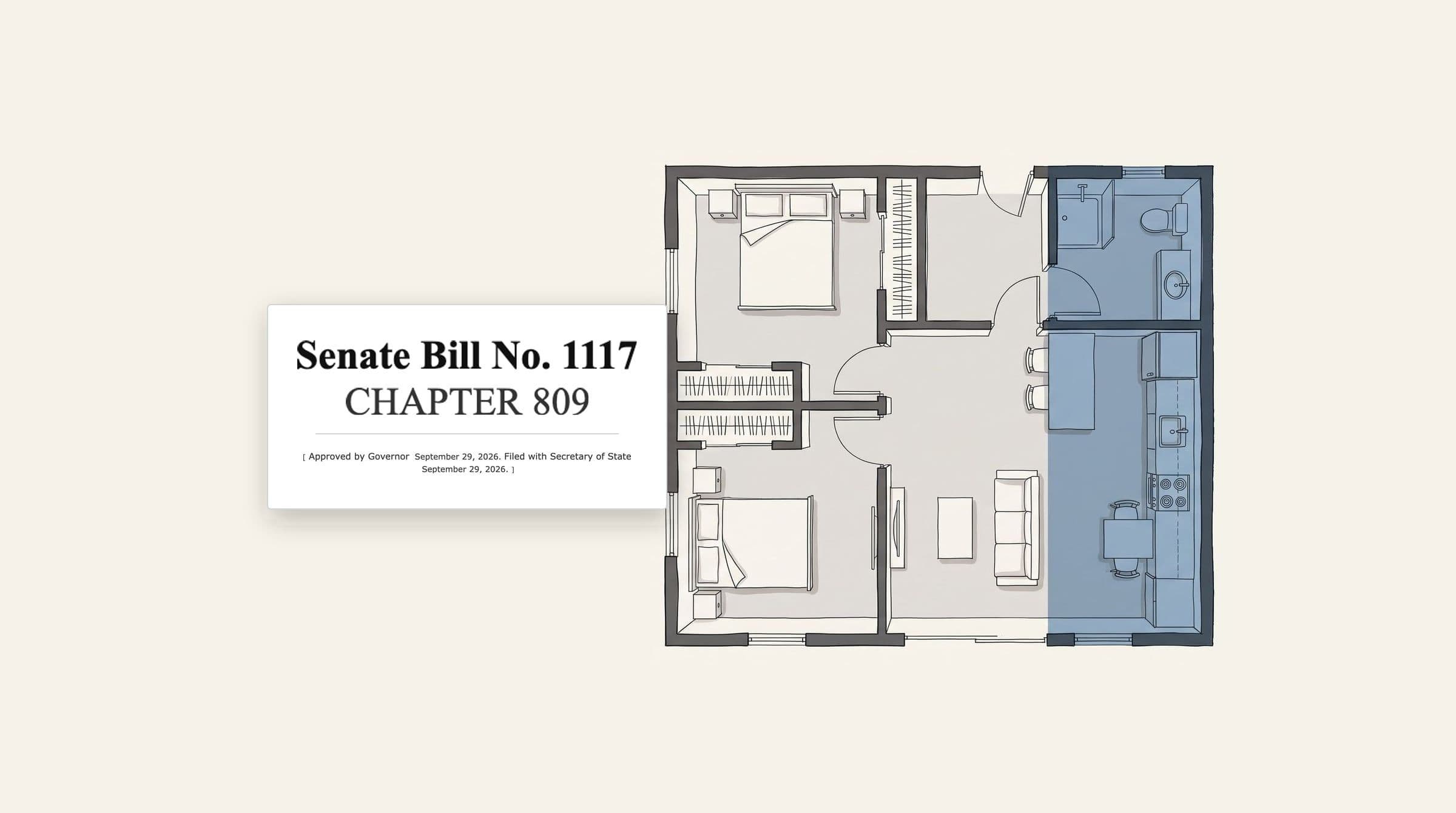
For years, 750 square feet has been the number that shapes ADU design in California. At or below it, state law blocks cities, special districts, and water agencies from charging impact fees on the unit. Go one square foot over and, in many jurisdictions, the fee math started from the first square foot. Senate Bill 1117 changes that. Starting January 1, 2027, ADU impact fees in California are charged only on the interior space above 750 square feet, on lots with up to two ADUs.
This post covers what impact fees are, how the old rule worked, exactly what SB 1117 changes, what it leaves alone, and why the answer looks different inside the City of San Diego than it does in Chula Vista, El Cajon, Escondido, National City, or the unincorporated county.
What ADU impact fees are (and what they are not)
Impact fees, often called development impact fees or DIF, are one-time charges a city or county collects when new construction adds demand on public facilities: parks, fire stations, libraries, roads, and similar. Under California's Mitigation Fee Act, an agency has to tie each fee to a specific facility and show a reasonable relationship between the fee and the project's impact. Special districts and water corporations can charge their own impact fees, and park fees under the Quimby Act count as well.
Three other charges show up on an ADU project that are not impact fees under this part of the law. SB 1117 does not touch any of them:
- Utility connection fees and capacity charges from the water and sewer provider. These follow a separate rule that requires them to be proportionate to the ADU's burden, measured by square footage or plumbing fixture count.
- School district fees. These use a separate 500 square foot threshold. An ADU under 500 square feet is not treated as adding assessable space. Above that, a school district may charge its per-square-foot fee.
- Plan check, permit, and inspection fees, which pay for processing the application rather than mitigating impacts.
In the City of San Diego, the General Plan Maintenance Fee also applies to every ADU and JADU regardless of size, per the city's Information Bulletin 400. Keep these categories separate when you read a fee estimate. A lot of the confusion around the 750 square foot rule comes from treating every line on the estimate as an impact fee.
The old rule: the 750 square foot cliff
Government Code section 66311.5 has exempted ADUs of 750 square feet or less of interior livable space from impact fees since 2020, along with JADUs of 500 square feet or less. Above 750 square feet, the law said fees "shall be charged proportionately in relation to the square footage of the primary dwelling unit."
In practice, proportionately meant the ADU's size relative to the main house. A 1,000 square foot ADU behind a 2,000 square foot house was charged half of what a brand new single-family home on the same lot would pay. Every one of those 1,000 square feet counted, including the 750 that would have been exempt in a slightly smaller unit.
That created the cliff. A 750 square foot ADU paid no impact fees. A 760 square foot ADU paid on all 760. Designers across the state learned to hold plans at 749 or 750, and some homeowners gave up the second bedroom or the larger kitchen they actually wanted. The bill's sponsor called it an arbitrary penalty. The author described the fix as aligning the calculation with what the Legislature meant in the first place.
What SB 1117 changes on January 1, 2027
Governor Newsom signed SB 1117 on September 29, 2026. It takes effect January 1, 2027, and it applies to every city in California, including charter cities like San Diego.
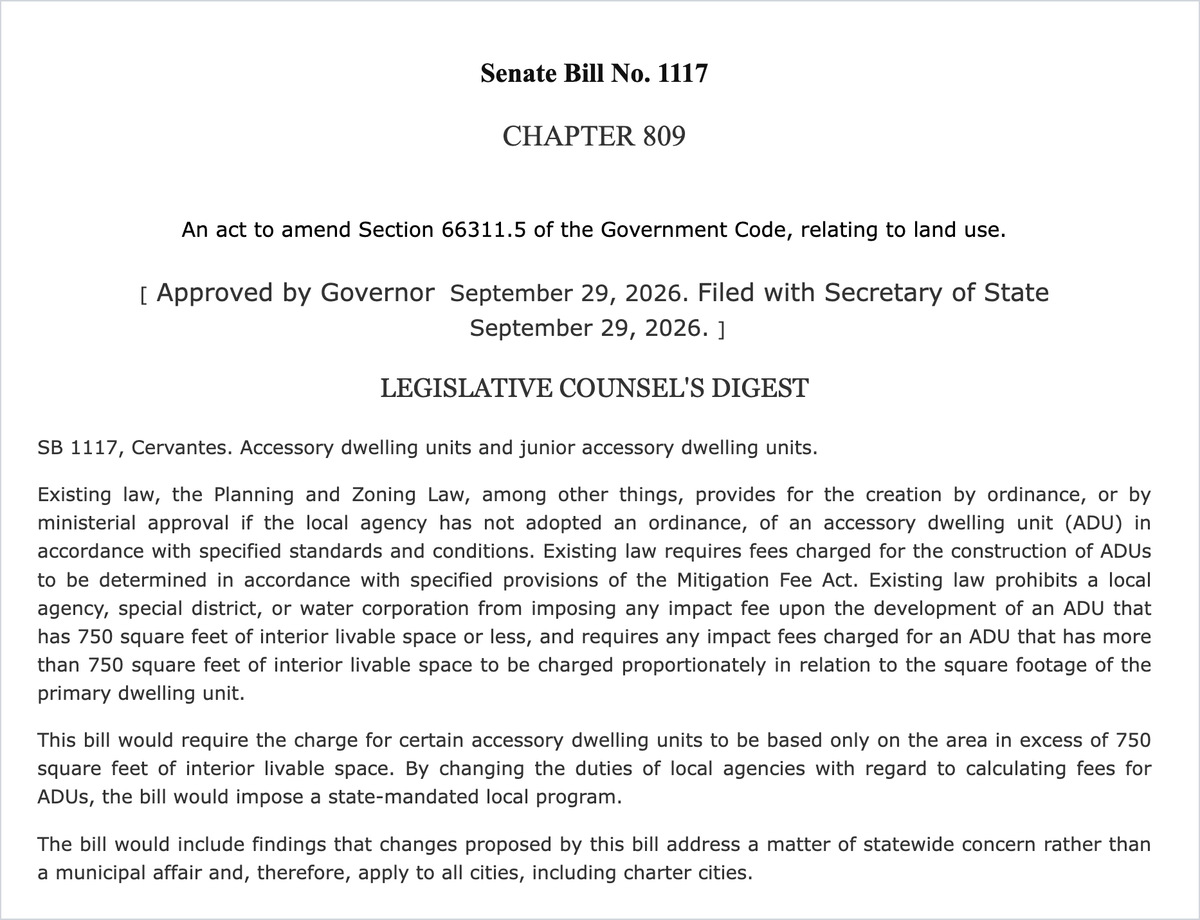
The operative change is one clause added to section 66311.5. On a lot with up to two ADUs, impact fees on an ADU over 750 square feet are still charged proportionately to the primary dwelling, "and only on the area in excess of 750 square feet of interior livable space."
Here is what that does to the chargeable area, before any proportional adjustment for the size of the main house:
| ADU interior livable space | Chargeable area under the old rule | Chargeable area under SB 1117 |
|---|---|---|
| 750 sq ft | 0 sq ft (exempt) | 0 sq ft (exempt) |
| 760 sq ft | 760 sq ft | 10 sq ft |
| 800 sq ft | 800 sq ft | 50 sq ft |
| 1,000 sq ft | 1,000 sq ft | 250 sq ft |
| 1,200 sq ft | 1,200 sq ft | 450 sq ft |
Take the 1,000 square foot ADU behind a 2,000 square foot house again. Under the old rule its fee basis was 1,000 square feet, or half the new-home fee. Under SB 1117 its fee basis is 250 square feet, or one eighth of the new-home fee. The rate per square foot has not changed. The area the rate applies to has.
Two details matter when you read your own plans against this:
- The measure is interior livable space, not gross floor area. SB 543, which took effect at the start of 2026, settled that question for state ADU law. Covered porches, garages, and wall thickness do not count toward the 750.
- The new calculation is limited to up to two ADUs on the lot. On a lot with three or more ADUs, any unit over 750 square feet goes back to the old full-area proportional calculation.
Ready to start your project?
Schedule a free consultation with our team to discuss your project. We'll tell you what's needed and give you a clear quote, no obligation.
What stays the same
SB 1117 is a narrow fix, and it helps to be clear about what it does not do:
- ADUs of 750 square feet or less and JADUs of 500 square feet or less stay fully exempt from impact fees.
- Utility connection fees, capacity charges, and school fees are untouched. They follow their own rules and thresholds.
- Cities and districts still set their own per-square-foot rates through nexus studies. The bill changes the area those rates apply to, not the rates themselves.
- It does not change how large an ADU you are allowed to build. Size, height, and setback limits still come from state ADU law and your local ordinance. For how those limits play out on a San Diego lot, see Can I Build an ADU on My Property in San Diego?
- It does not address projects already in review. The bill does not say whether the application date or the fee assessment date controls for an ADU permitted in 2026 and finaled in 2027.
What it means on a San Diego County lot
Here is where the local answer splits, and where most statewide coverage of SB 1117 misses something.
Inside the City of San Diego, which includes La Jolla and most of the neighborhoods people mean when they say San Diego, the municipal code already goes further than the state. Section 142.0640 exempts the first two ADUs on a premises from Development Impact Fees regardless of size. The exception is units built through the ADU Home Density Bonus Program, where an ADU over 750 square feet does pay. So if your lot is in the city and you are building one or two standard ADUs, you were not paying city DIF before SB 1117 and you will not be paying it after. The state law change matters for bonus program units and for any other agency that charges a true impact fee on your lot. The city code also bases DIF on the fee schedule in effect when your application was deemed complete or when the fees are paid, whichever is lower, which is worth knowing if you are mid-process.
In the rest of the county, SB 1117 does real work. Chula Vista, El Cajon, Escondido, National City, and the unincorporated areas under County Planning & Development Services each have their own impact fee programs, and they apply the state proportional rule to ADUs over 750 square feet. A homeowner in El Cajon or Escondido who wants an 850 or 1,000 square foot unit is the person this bill was written for. Fire protection districts and other special districts that charge impact fees in the unincorporated county fall under the same change.
If your project is already in review, ask your jurisdiction in writing which date it will use before you pull the permit. Impact fees are generally collected at final inspection or certificate of occupancy, so a unit permitted in late 2026 may not pay its fees until the new rule is in effect. The bill does not resolve that question, and each agency may answer it differently.
On sizing, 750 square feet is no longer a wall. It is still the point where impact fees start, so a 760 square foot plan is not free, but the penalty for crossing it has shrunk to the extra 10 square feet. That frees the size decision to rest on what it should rest on: the lot's setbacks and coverage, how the unit will be used, and whether a second bedroom or a full kitchen is worth the added construction. Our post on ADU floor plans in San Diego walks through what each size range actually buys you.
Common questions about SB 1117
Does SB 1117 apply to junior ADUs?
A JADU is capped at 500 square feet, so it never reaches the 750 square foot threshold. JADUs of 500 square feet or less remain fully exempt from impact fees, as they were before.
Does it apply to a garage conversion?
Yes, if the converted unit is an ADU with more than 750 square feet of interior livable space. Most garage conversions come in well under that, since a two-car garage is usually in the 400 to 500 square foot range. Conversions of existing space also have their own protection from new utility connection fees under a separate part of section 66311.5.
Does it lower my water or sewer connection fees?
No. Connection fees and capacity charges are not impact fees under this section of law. They have their own proportionality rule, and SB 1117 leaves it alone.
My ADU is already permitted. Does anything change?
The bill is forward-looking and does not provide refunds. If your fees have not been paid yet because your project has not reached final inspection, ask the jurisdiction in writing how it will handle the transition.
Does it change how many ADUs I can build?
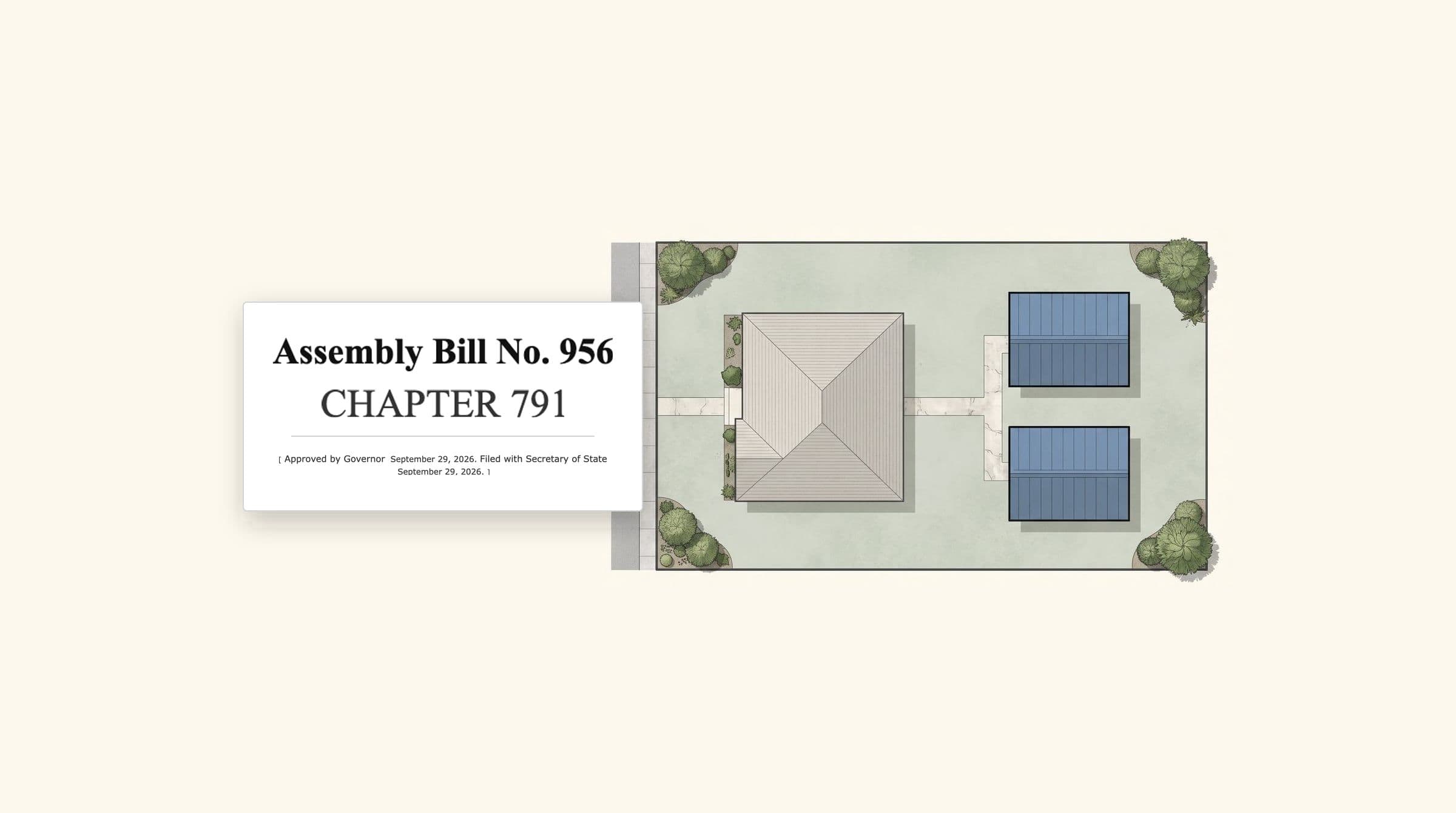
No. That is a separate bill. AB 956, signed the same day, allows two detached new-construction ADUs on a single-family lot starting in 2027. SB 1117's two-ADU limit on the new fee calculation lines up with it.
Planning an ADU size around the new rule
You now know what an impact fee is and what it is not, how the 750 square foot cliff worked, what SB 1117 changes on January 1, 2027, and why a lot inside the City of San Diego reads differently from one in Chula Vista or El Cajon. The fee rule is one input into the size decision. Setbacks, lot coverage, height, utility routing, and how your household will use the unit matter more.
Getting those inputs right early is where a designer who also handles the permit set earns their keep. BluPlan Studio designs ADUs for homeowners across San Diego County and prepares the permit drawings and processing for each jurisdiction. As part of ADU design, we flag which fee rules apply to your specific lot so the size you choose is a deliberate one. Schedule a free consultation to talk through your project.