AB 956: California Will Allow Two Detached ADUs on a Single-Family Lot in 2027
What the new law requires cities to approve, what it trades away, and what it actually takes to fit two backyard units on a San Diego lot.
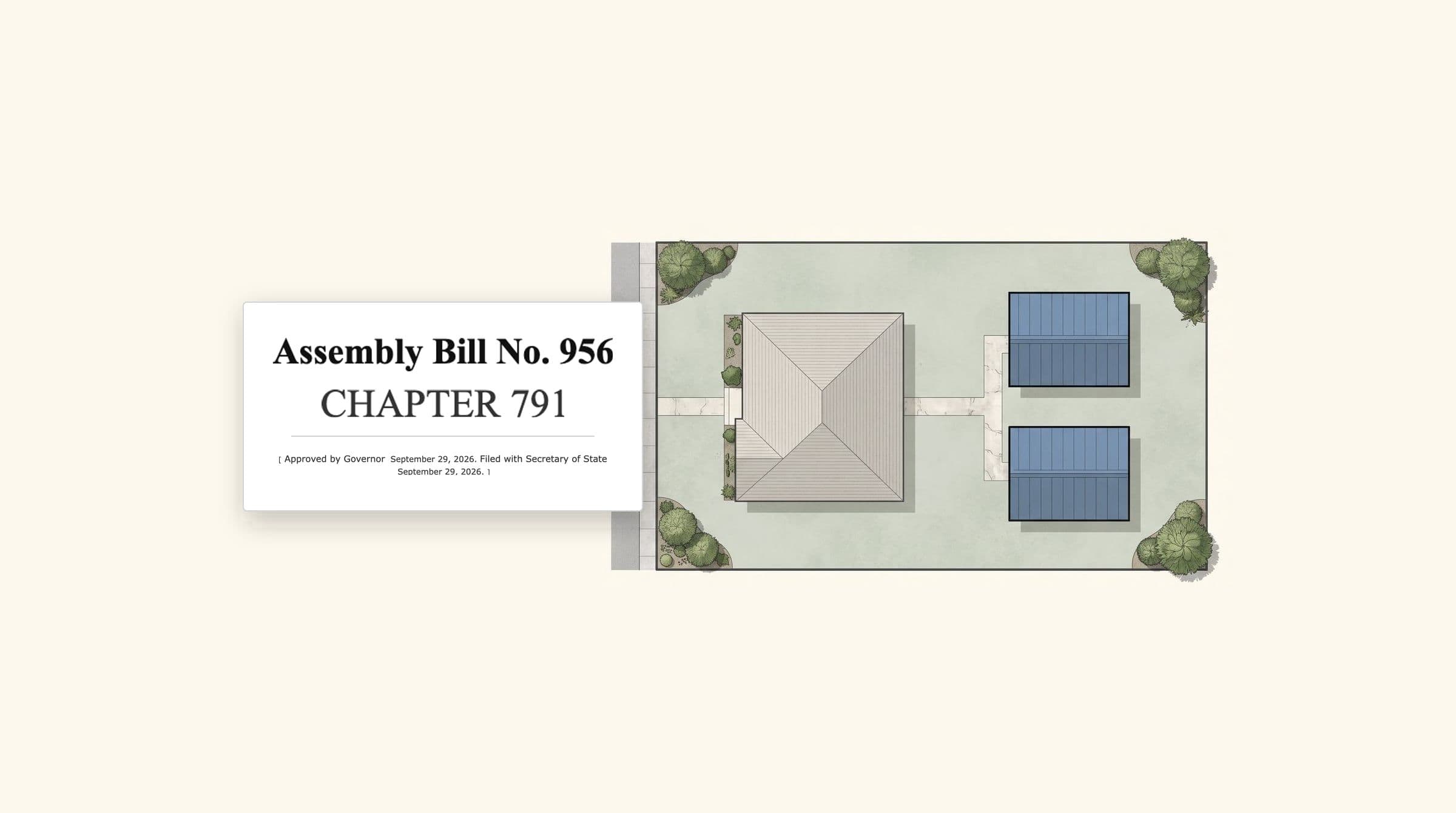
For years the state guarantee on a single-family lot in California was one detached backyard unit. You could add a converted ADU inside the house or garage and a junior ADU within the walls of the home, but only one new, freestanding structure had to be approved. Assembly Bill 956 changes that number to two. Starting January 1, 2027, a city must ministerially approve two detached ADUs in California on a lot with an existing or proposed single-family home, as long as each unit meets the conditions already in state law.
That is a real change, and it has drawn more attention than any ADU bill since the 2019 package. It also comes with a trade-off, a fix for homeowners associations that most coverage glosses over, and a practical question the law cannot answer for you: whether two units physically fit on your lot. This post covers all of it, with the San Diego County specifics where they matter.
What the law allowed before AB 956
California ADU law has two tracks, and most confusion about "how many ADUs can I build" comes from mixing them up.
The first track is Government Code section 66323, the units a city must approve with no discretionary review and almost no local standards. On a single-family lot that set has been:
- One ADU converted from existing space, such as a garage or part of the house, plus one junior ADU of no more than 500 square feet inside the home.
- One detached, new-construction ADU of up to 800 square feet of interior livable space, with side and rear setbacks of no more than four feet.
A city cannot apply lot coverage, floor area ratio, front setback, parking, or design standards to these units. They are approved on the state's terms.
The second track is the ordinary ADU under section 66314, where a city may apply objective standards like a front setback or a size cap, within state limits. Most larger San Diego ADUs, including anything over 800 square feet, go through this track.
So before AB 956, a typical single-family lot could carry the main house, a conversion ADU, a JADU, and one detached unit, with a second larger ADU possible under local standards. The piece that was fixed at one was the detached, by-right structure.
What AB 956 changes
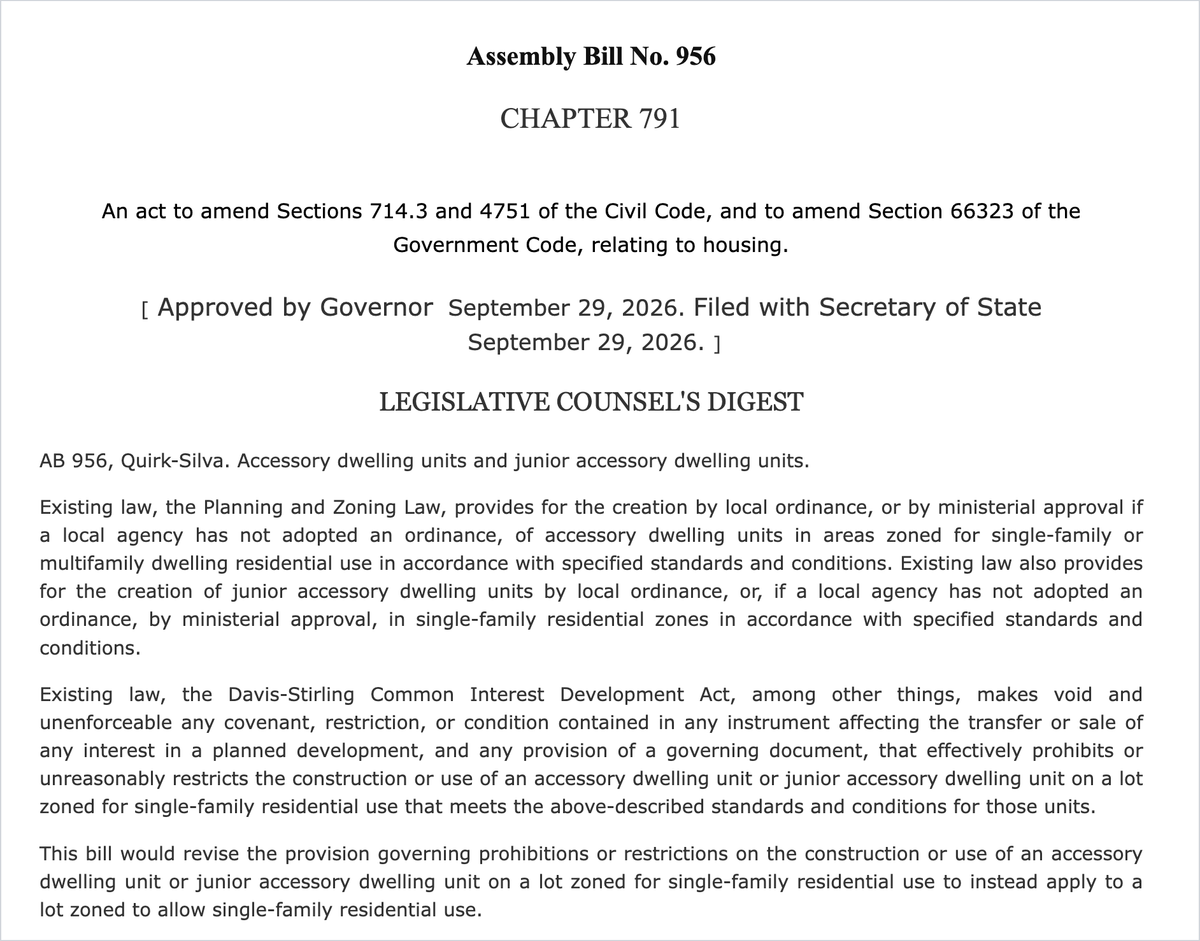
Governor Newsom signed AB 956 on September 29, 2026, as Chapter 791 of the 2026 statutes. It takes effect January 1, 2027. The author is Assemblymember Sharon Quirk-Silva, and California YIMBY sponsored it. It passed the Assembly 58 to 4 and the Senate 27 to 6.
The operative change is to section 66323. The one detached, new-construction ADU a city must approve becomes two. Both units are still bound by the same conditions:
- No more than 800 square feet of interior livable space each. A city may allow larger, but it does not have to.
- Side and rear setbacks of no more than four feet.
- The state height floor, which is 16 feet in most locations and 18 feet within half a mile of a major transit stop, with two more feet allowed to match the main house's roof pitch.
- No parking requirement, no owner-occupancy requirement, and no short-term rentals.
The conversion ADU still rides alongside them. Section 66323 allows the listed units in any combination, so one converted unit plus two detached units on the same lot is within the by-right set.
The JADU trade-off
Here is the part to read twice. AB 956 adds a carve-out: where two detached, new-construction ADUs have been built, the city is not required to approve a junior ADU on that lot. A city may still allow it, but the state guarantee stops at two detached units or one detached unit plus a JADU.
The Senate analysis is candid about why. SB 9 and ADU law together have functioned as a four-unit cap on a single-family parcel, and the Legislature wanted AB 956 to stay inside it. For a homeowner, the practical question is whether a second freestanding unit is worth more than a 500 square foot unit inside the existing house. For many lots the answer is yes. For a household that wanted the JADU for a parent and a single rental unit out back, the old arrangement may still be the better one.
One detail the bill does not settle is sequence. If a JADU already exists and the owner later applies for two detached units, the statute does not say how the city should treat it. Ask the planning counter in writing before you commit to plans.
The HOA fix most coverage skips
The second thing AB 956 does is narrower but matters a great deal in parts of San Diego County.
Since 2019, Civil Code section 4751 has made void any covenant or HOA rule that effectively prohibits or unreasonably restricts an ADU on a lot "zoned for single-family residential use." In April 2026 a San Diego County Superior Court judge read those words literally in a Carlsbad case. Because the owner's parcel allowed townhomes and small condominiums as well as single-family homes, the court held the protection did not apply, and the HOA's ban on garage conversions stood. The ruling got statewide attention, and CalMatters covered it as a signal that HOAs had found a gap.
AB 956 closes the zoning half of that gap. The protection now applies to any lot "zoned to allow" single-family residential use, which reaches the many older San Diego houses sitting on land zoned for multifamily. The court's other ground, that the law did not reach condominium developments, is a separate question. AB 956 left section 4751's planned development language in place, so condominium owners should not assume it resolves their situation. The bill makes the same "zoned to allow" change to Civil Code section 714.3, the parallel rule for covenants in deeds and other instruments affecting real property.
If you own a house in a planned development with an HOA, the association can still enforce reasonable restrictions. Under section 4751, those restrictions cannot effectively prohibit the unit, unreasonably increase the cost to build it, or extinguish your ability to build it.
Ready to start your project?
Schedule a free consultation with our team to discuss your project. We'll tell you what's needed and give you a clear quote, no obligation.
What AB 956 does not change
- SB 9 lot splits. A parcel created by an urban lot split is still capped at two units total. You cannot split the lot and then put two detached ADUs on each half.
- Size. The by-right detached unit is still 800 square feet. Larger detached ADUs still go through the local-standards track. Our guide to ADU floor plans in San Diego walks through what each size range gives you.
- Building, fire, and utility codes. Ministerial approval means no discretionary hearing. It does not mean no plan check. Two units mean two sets of utility connections to size, and in San Diego's High and Very High Fire Hazard Severity Zones the city requires four-foot setbacks around every structure for defensible space and proof of two evacuation routes.
- Multifamily lots. AB 956 is about single-family lots. The multifamily rules, including up to eight detached units on lots with existing apartments, are unchanged.
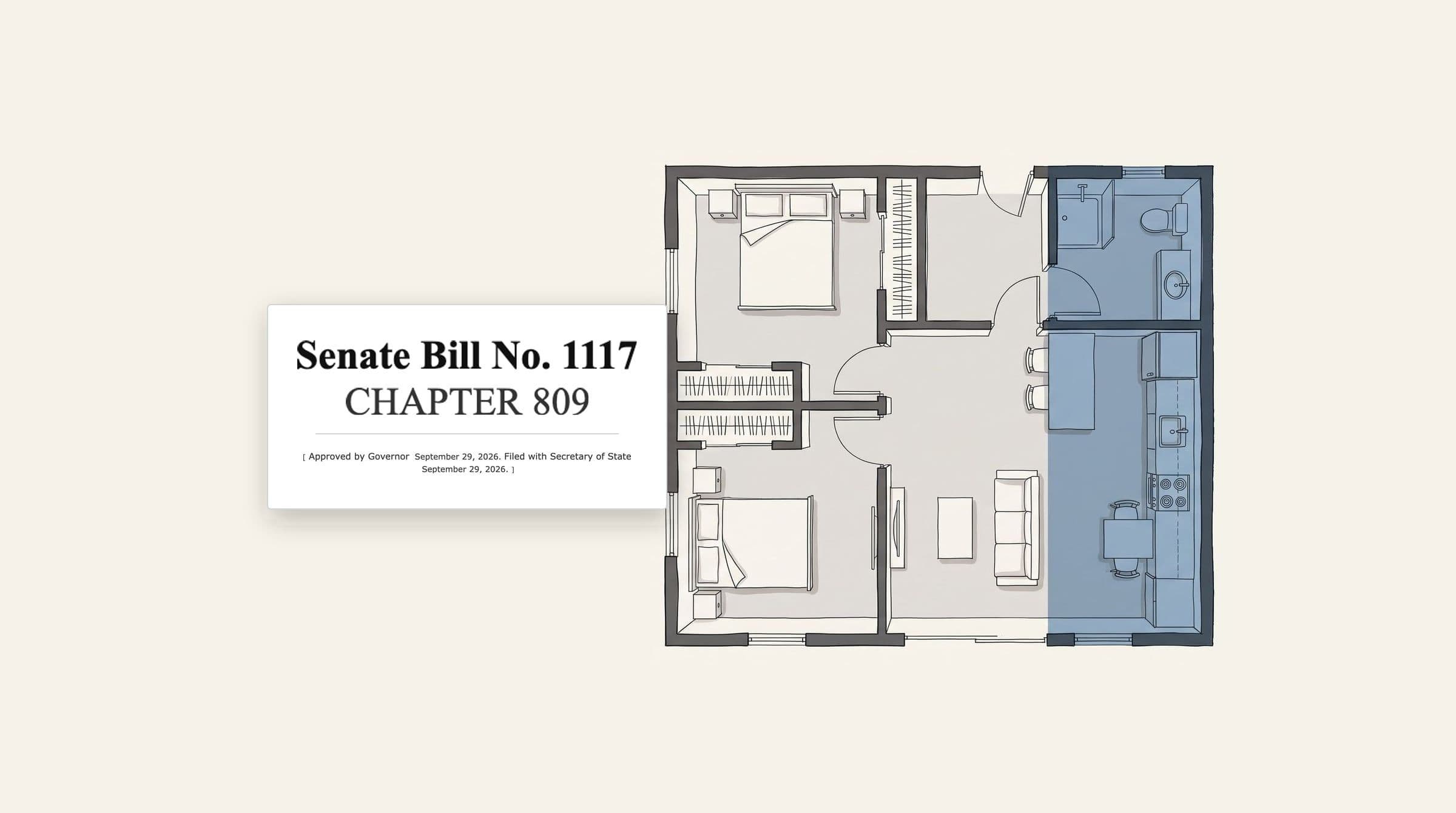
- Impact fees. Those are governed by a companion bill signed the same day. SB 1117 limits impact fees to the space above 750 square feet for up to two ADUs on a lot, which lines up with AB 956. Two 800 square foot units would each be assessed on 50 square feet outside the City of San Diego, and inside the city the first two ADUs are already exempt from city impact fees regardless of size. Adding a garage conversion puts three ADUs on the lot, which takes any unit over 750 square feet out of the new calculation.
What two detached ADUs take on a San Diego lot
The law sets a floor. Your lot sets the ceiling. Before anyone draws two units, these are the questions a designer works through.
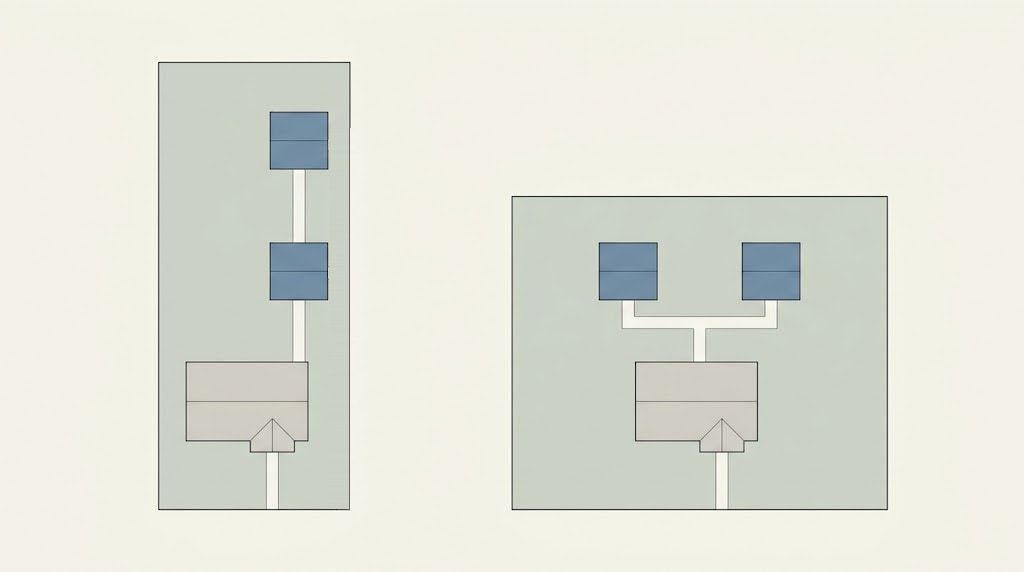
Rear yard depth and width. Two 800 square foot units at four-foot setbacks need either a deep lot that can take them in sequence or a wide one that can take them side by side. On a standard older San Diego lot, that often means one unit goes two stories, which the state permits as long as it stays within the height limit. Stacking changes the structural design, the stair footprint, and the neighbor relationship.
The existing garage. Many lots already have a detached garage at the rear. Converting it uses the conversion ADU slot, which is separate from the two detached slots, so a garage conversion plus two new detached units is within the by-right set. Demolishing it to make room is also common, and the demolition permit is reviewed with the ADU permit.
Utilities. Each new unit needs water, sewer, and electrical service sized for it. A single existing service can often carry one ADU. Two may push a panel upgrade or a new sewer lateral, and that is often what decides the budget, not the framing.
Fire access and hazard zones. Much of the eastern and northern city, along with large parts of Escondido, El Cajon, and the unincorporated county, sits in a mapped fire hazard zone. The four-foot defensible-space setback applies to every structure on the lot, and the lot has to front an improved street with two ways out.
Coastal and historic overlays. La Jolla, Point Loma, and the coastal strip can trigger coastal review even for by-right units, and designated historic properties have their own path.
Local code catching up. The City of San Diego rewrote its ADU regulations in August 2025 and will need to amend them again for AB 956. Chula Vista, El Cajon, Escondido, National City, and the county are in the same position. Until a local ordinance is updated, state law controls wherever the local rule is less permissive, but counter staff may read the new law differently in its first months. Get the city's position in writing.
If your lot has not been through the first question yet, start with Can I Build an ADU on My Property in San Diego? and come back to this one once the answer is yes.
Common questions about AB 956
Can I build a second detached ADU if I already have one?
Yes, from January 1, 2027, if the lot has a single-family home and the new unit meets the 800 square foot, four-foot setback, and height conditions. The existing unit counts as one of the two.
Can both units be two stories?
State law requires a city to allow at least two stories where the height limit and building code permit it, and a city cannot deny a two-story detached ADU just because the main house is limited to one story. Whether two stories make sense on your lot is a design question.
Can I still build a JADU?
If you build two detached ADUs, the city is not required to approve a JADU too. Some cities will allow it anyway. If the JADU matters to your plan, confirm with the planning department before you choose two detached units.
Does my HOA still get a say?
An HOA in a planned development can enforce reasonable restrictions on an ADU. It cannot effectively prohibit the unit or impose restrictions that unreasonably increase the cost to build it. Condominium associations are a different case and were not clearly addressed by AB 956.
Does this apply to a duplex or a lot with two houses?
AB 956 is written for lots with an existing or proposed single-family dwelling. Lots with a duplex or apartment building follow the multifamily ADU rules, which did not change.
Designing for two units instead of one
You now know what AB 956 guarantees, what it trades away, how it fixed the HOA zoning gap, and the questions that decide whether two detached units fit on a San Diego lot. The law makes the second unit approvable. Setbacks, utilities, fire zones, and the shape of your yard decide whether it is buildable, and in what form.
That is the work BluPlan Studio does for homeowners across San Diego County: the ADU design, from the first lot study through the drawings, and the permit drawings and processing for whichever jurisdiction your lot sits in. If you are weighing one unit against two, the lot study is where that decision gets made. Schedule a free consultation to talk through your project.